If we wouldn’t want it for our family, we wouldn’t ask you to use it near yours. We don’t formulate our products with these ingredients:
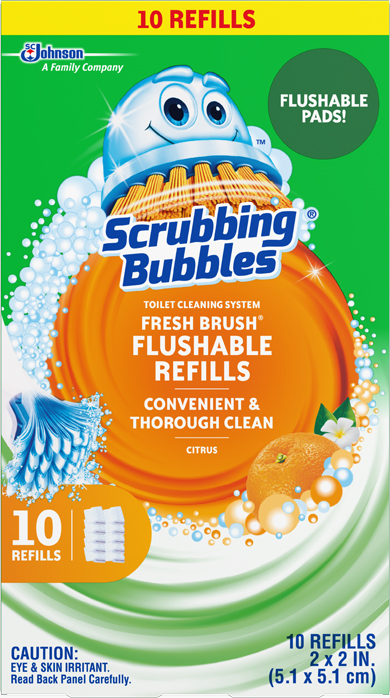
Flushable toilet cleaning pads that make it easy to loosen and clean daily soils and stains.
Provides a non-abrasive surface for scrubbing.
Break down dirt and deposits.
3-(3-Hydroxypropoxy)Propan-1-ol is a cleaning agent that removes dirt and deposits. It does this by surrounding dirt particles to loosen them from the surface they're attached to, so they can be rinsed away.
Ethoxylated Alcohol is a cleaning agent that can also be found in a variety of products including toothpaste and shampoos. It removes dirt and deposits by surrounding dirt particles to loosen them from the surface they're attached to, so they can be rinsed away. Ethoxylation is the process of treating a fatty acid alcohol to give it detergent properties.
Sodium Laureth Sulfate is a cleaning agent that can also be found in toothpastes, shampoos, lathers and bubble baths. It removes dirt and deposits by surrounding dirt particles to loosen them from the surface they're attached to, so they can be rinsed away. Over the years, Sodium Laureth Sulfate has received some bad press due to emails that began circulating in the late 90s regarding alleged cancer concerns related to Sodium Laurel Sulfate, a different but related ingredient.
Click here to learn more about our fragrance palette.
Provides a pleasing color for a product.
Acid Blue 9 is a colorant. It is one of the most widely used and tested dyes in consumer products, and can be found in clothing and colored paper. Dyes are added to products for a variety of reasons including helping you see where you applied the product, when a product is used up, or for aesthetic reasons.
Holds the product ingredients together.
Hydroxyethyl Cellulose is a thickener that can also be found in cosmetics and personal care products such as makeup, skin care products and shaving cream. It improves the texture of a product and, as needed in some formulas, helps a product to cling to surfaces such as a toilet bowl. In some products, Hydroxyethyl Cellulose can also be used as a binder, which helps ingredients hold together.
Removes soap scum and soils.
Etidronic Acid is a chelator that can also be found in soaps, moisturizers and tooth whitening products. It removes soap scum and mineral deposits that are caused by hard water. The word chelator (pronounced "key-lay-tor") comes from the Greek word chele, or claw. Think of a chelator as a tiny claw that reaches out and grabs the minerals in soap scum or soils, to keep them from depositing on a surface. By binding to the soap scum or deposit, Etidronic Acid allows them to be rinsed away.
Adjusts the pH of a product to improve stability.
Sodium Hydroxide is a builder that can also be found in detergents and degreasers. It makes a product formula clean better by affecting the molecules in the formula so they work together better. Sodium Hydroxide can also be a pH adjuster that alters the pH of a product to improve stability. Every formula has an optimum pH to make it work best. For example, a formula that’s more acidic works better for soap scum removal. Its opposite, a formula that’s more alkaline, might be more effective at removing grease or greasy soils. We use pH adjusters to make sure we achieve the best pH for a particular job. Also, the pH of a formula can affect how long it lasts within a container – for example limiting its tendency to rust in a can. In high concentrations (such as in drain cleaners), Sodium Hydroxide can also be used as a caustic that helps dissolve organic matter like drain clogs.
Protects a product against microbial growth to maintain performance.
2-Bromo-2 Nitropropane-1,3-Diol is a preservative. It helps maintain product quality and performance over time. Some people raise concerns about preservatives, because a small number of individuals have allergies to them just as some people have allergies to nuts or bees. But preservatives play a very important role in food, cosmetics and household products. Without preservatives, many products would not last more than a week or two before being contaminated by bacteria, mold or yeast. So, we feel the best choice is to add preservatives in the smallest effective quantity to protect our products, but to list these preservatives in our formulas so that those with allergies in the family can make informed choices.