If we wouldn’t want it for our family, we wouldn’t ask you to use it near yours. We don’t formulate our products with these ingredients:
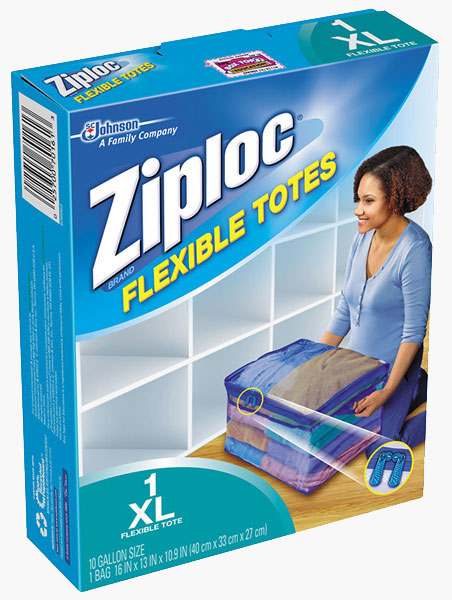
Soft-sided, rectangular storage bags that are great for everyday and long-term storage. Unlike rigid containers, they stay folded away until needed.
A polymer used to form a plastic bag.
Nylon is a synthetic polymer with many, many uses. It was originally intended as a replacement for silk. Today it's used in many different ways from clothing to rope to strings for musical instruments. We use nylon in the zip closure of plastic bags. It is approved for use in products that come into direct contact with food. Nylon can withstand both heat and freezing. Check your product label for more information and rest assured that Ziploc® Brand products that are marked as "microwaveable" meet the safety requirements of the U.S. Food and Drug Administration (FDA) for temperatures associated with defrosting and reheating food in microwave ovens, as well as room, refrigerator, and freezer temperatures.
Polyester is a polymer that can be used to form a plastic bag. It can also be used as a thread, for example in Ziploc® Brand Flexible Totes. It is approved for use in products that come into direct contact with food. Polyester can withstand both heat and freezing. Check your product label for more information and rest assured that Ziploc® Brand products that are marked as "microwaveable" meet the safety requirements of the U.S. Food and Drug Administration (FDA) for temperatures associated with defrosting and reheating food in microwave ovens, as well as room, refrigerator, and freezer temperatures.
Polyethylene-Low Density is a polymer that can be used to form a plastic bag and its zip closure. It is part of the Polyethylene (PE) family, which is the most widely used plastic. Polyethylene-Low Density, also known as LDPE, is commonly used in rigid plastic containers. We use a mix of different polyethylene densities to get the ideal strength and flexibility for different bag types. It is approved for use in products that come into direct contact with food. Polyethylene-Low Density can withstand both heat and freezing. Check your product label for more information and rest assured that Ziploc® Brand products that are marked as "microwaveable" meet the safety requirements of the U.S. Food and Drug Administration (FDA) for temperatures associated with defrosting and reheating food in microwave ovens, as well as room, refrigerator, and freezer temperatures.
Seals the seams of Ziploc® Brand Flexible Totes.
For competitive reasons, the supplier of this resin blend binding tape has asked us to keep the details confidential, and we're legally bound to do so. But we can tell you that it's a special tape that seals the seams of a Ziploc® Brand Flexible Tote. And, it has met our strict Greenlist™ standards for health and environmental effects.
Provides a pleasing color for a product.
Ultramarine Blue 2946 is a colorant. Dyes are added to products for a variety of reasons including for aesthetics, such as giving a tint to the plastic of a bag or container. Ultramarine Blue 2946 can also be used as an ink, which adheres to a surface to produce an image or text, for example printing information on a plastic bag. It is a product of Nubiola Grupo.
White Ink G09 is an ink, which is a liquid that contains pigments or dyes to provide color. Inks are designed to adhere to a surface to produce an image or text. White Ink G09 is a water-based, food-safe ink used to print information on a plastic bag. It is a product of DIC Graphics Chia Lung Corp.